The Line of Discernment & The Six Struggles of Daily Life


As seen in The Manual: A Guide to Achievement & Enlightenment in the Urban Community
This time last year I was scribbling in the a notebook in my backyard working out the basic precepts of my book, The Manual: A Guide to Achievement & Enlightenment in the Urban Community. At first, I didn’t think anyone would care about the struggles of a young dude from Lakeland, FL, but time kind of taught me otherwise and now everyone’s asking questions about a specific part of The Manual, the Line of Discernment, seen above.
What the system essentially does is distill the millions of individual struggles human beings face on an everyday basis into six key battles, each with a positive and negative side.
A problem I noticed in my neighborhood is that most people find themselves dominated by these six negative emotions for one of two reasons.
1) Because they’ve known nothing else their entire lives
2) Because they let a certain negative emotion (Fear) block their potential connection to a positive one (Love)
The Line of Discernment focuses on balance rather than sticking to one end of the spectrum. You don’t need any one to make you feel worse for your shortcomings any more than you need someone to tell you your problems don’t exist. You need someone to let you know that you’re slipping just as much as you need a pat your back when you do good works. Most importantly, you need to know that you’re in control of your emotions, and that buried under all that fear, anger, shame, and vanity is an awesome person, waiting to be let off of the leash.
So I literally set each of the six battles in my own neighborhood. I grabbed friends from around the city, and shot each battle within three blocks of my house.
Here’s an excerpt from The Manual. This is the first battle, the one between Faith and Fear. Featuring my neighbor Shammar Byrd.
Lakeland Resident Shammar Byrd.
Battle One: Faith vs. Fear
Image: The Hopper
Imagine the life of a thirteen-year-old corner boy. After seeing a few dead bodies,
a few friends get arrested, and a few girls leave him broken-hearted, the
fear becomes too much to overcome. Rather than fight it, he embraces it. It
keeps him on the corner, keeps him away from police, and keeps him in the
crowd of his peers. He remains on the corner hidden behind his ice grill, paralyzed
by fear.
Our corner boy isn’t too much different from many other young people his
age. It’s usually around puberty that people set up their protection patterns.
This is a system of behavior that seeks safety in fear-based emotions like
doubt, arrogance, unwillingness, apathy, impatience, self-pity, cruelty
and separateness.
Sound like anybody you know?
Fear-based emotions are primarily used as defense mechanisms when the
human mind detects a concern for survival. For example, the arrogant man
masks his inferiority by buying diamonds and gold and believing that they
make him better than everyone else. When he gets robbed for them, he’s
more inferior than he was before he bought the jewelry because now his
arrogance has led to his comeuppance.
The doubting woman believes all men are dogs, and all her friends are fools
for surrendering themselves to love. She soon grows old and alone, with
bitterness and regret as her only companions.
Notice how these situations lead to other fear-based emotions. Fear is like a
fire, consuming all unable to resist it.
Faith is water to fear’s fire. Confidence, humility, willingness, caring, patience,
kindness and unity all require a degree of faith to be genuine. And
they all lead to fear’s natural opposite, love.
But that’s a whole other battle entirely. Literally.

The Manual tells the story of a lot of different roles people allow themselves to play. When we’re unable to tell the difference between ourselves and the emotions we feel, we ended playing the role of The First-TIme Cheater, The Ever-Grieving Mother, The Mainstream Rapper, and most usually, The Fool. It’s important to note that the LOD isn’t a battle between positive and negative emotions, but between negative emotions and positive qualities. Emotions are fleeting, but quality lasts as long as the person wants it there.
Now I’m a follower of Christ that believes in God, but when people ask where the physical inspiration for the LOD system came from I say the same thing.
Hindu Metaphysics!
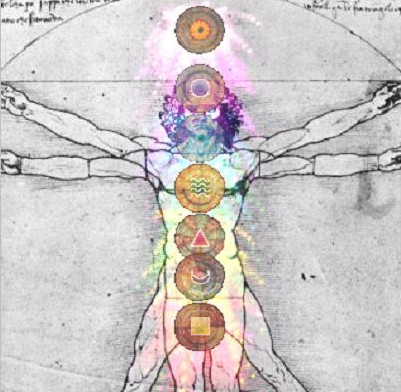
Before I get stoned, let me just say that scientists have actually found connections to the seven chakras (or energy centers) in the Human endocrine system, and each one has a direct connection to a certain part of the human body. For the Line of Discernment, I used those mental and physical places as a battleground.
And if you’re asking why there are only six battles, it’s because the seventh chakra deals with a term known as Samadhi, or a true connection with God. To the Hindus (who believe in the Resurrection of Christ, btw) a connection with God is one that can be reached by anyone who accepts God and works to get closer to him on a spiritual level.
So the Samadhi, the seventh battle, and being one with God isn’t exactly a battle or struggle at all. It’s simply a temporary union between the Creator and the created. As a Christian, this helped bring this full circle for me.